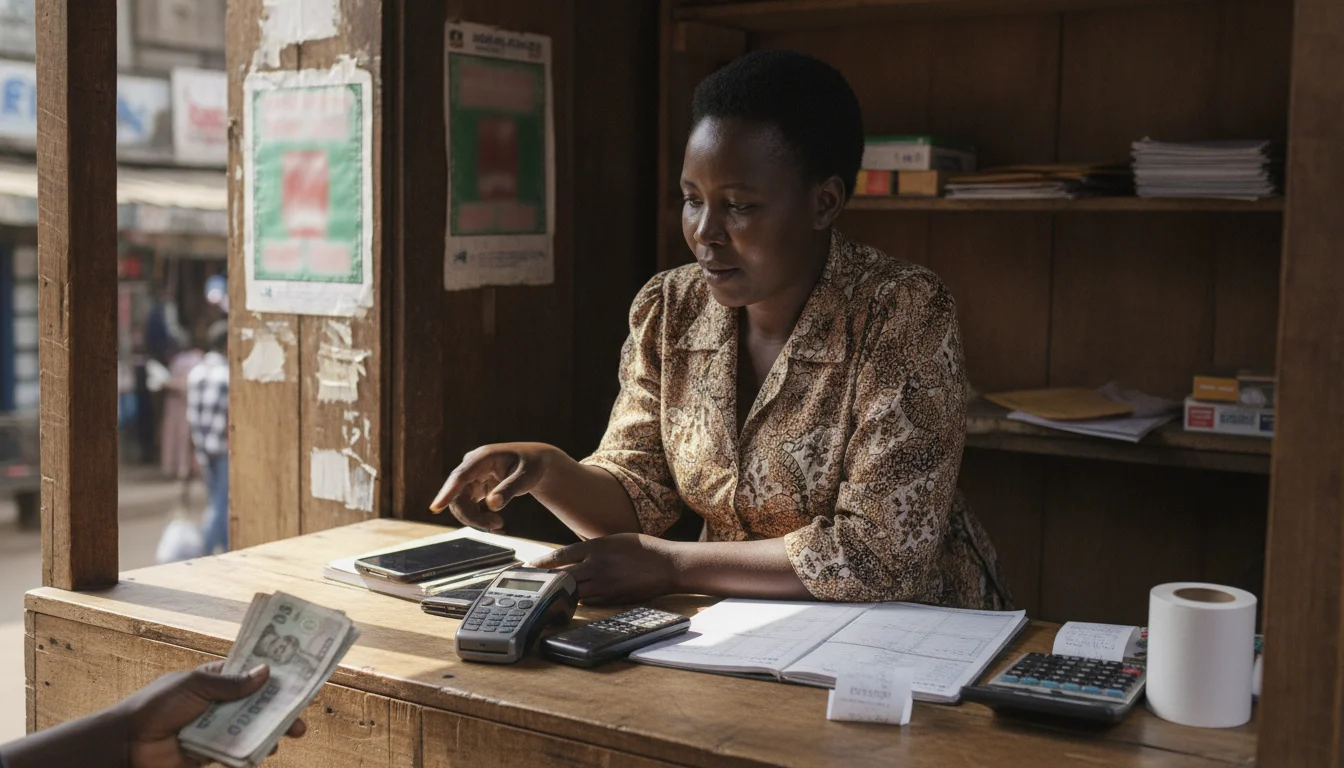
Paying straight from the phone already had no agent fee, and that stays the same.
What the three features actually are
The three sit inside the new M-PESA Super App (My OneApp), which rolled through 2026 and now carries all of this on one screen.
- Tap-to-Pay lets her tap her phone on the card reader at the shop counter, once the cashier has started the payment. She needs My OneApp and a phone with NFC, the feature that lets a phone pay by tapping. She checks the amount on her phone and enters her M-PESA PIN. Safaricom launched it on Pesapal terminals on 1 October 2026.
- Scan-to-Pay lets her point her camera at a QR code. On a QR sticker, she types the amount herself. On a code shown on the terminal, the amount fills in by itself. She checks the details and keys her PIN. She does not have to type a shop number, so she cannot mistype it.
- AI Pay lets her point her camera at a printed or handwritten receipt. Where the app can read it, it fills in the Buy Goods or PayBill details and the amount. She checks what it filled in and keys her PIN. The payment itself is still an ordinary PayBill or Buy Goods payment.
Scan-to-Pay and AI Pay lead to the same M-PESA payment paths your family was already using: Buy Goods for a shop, PayBill for a bill. The fee comes from the path, not from how she starts the payment. Safaricom lists no separate fee for Tap-to-Pay. A Buy Goods payment is free for the customer, except at a fuel station, and she sees the details before she enters her PIN.
What the shopper actually pays at the counter
When a shop takes Buy Goods, she pays nothing extra. M-PESA Buy Goods, which is the shop payment path, is free for the customer on every amount up to the single-transaction ceiling of KSh 250,000. Fuel stations are the exception: there, Safaricom has the customer pay the transaction charge. The shop pays a small merchant fee above KSh 500 (0.55 percent, capped at KSh 200). Until August 2026 the shop paid from KSh 201; Safaricom's August cut made payments of KSh 500 and below free for the shop. Outside fuel stations, the shopper's side was zero before the cut, and it is zero after.
PayBill is the household-bill side. The fee depends on which setup the biller is on, and  each business chooses its own. On Customer Bouquet, the business pays and the customer pays nothing.
On Business Bouquet, the customer pays a small fee by ladder. On the third setup, Mgao, the customer and the business split the charge. AI Pay works the same on every kind. Before she enters her PIN, she should look for a fee on the screen. After she pays, she should check the M-PESA message.
Catch
"Customer Bouquet" means the business is paying. "Business Bouquet" means the customer is paying. The English is the opposite of what it sounds like, so it is worth reading twice. The August 2026 fee cuts did not change what a customer pays into any kind of PayBill.
What she pays at the agent, if she still withdraws
The withdrawal ladder at an M-PESA agent runs from KSh 11 at the smallest band up to a flat cap of KSh 309 on anything from KSh 50,001 to the KSh 250,000 ceiling. On a £200 send, which arrives as roughly KSh 34,000, the band fee is around KSh 197, about £1.15. On a £300 send, which arrives as roughly KSh 51,700, she hits the top band, so KSh 309, about £1.80.
The October 2026 launch did not touch this fee, and she only pays it if she withdraws cash. For the portion of the money that gets spent in a shop, a matatu, a Kenya Power bill, a school fee, there is no agent fee because there is no agent. That path already existed. Tap-to-Pay, Scan-to-Pay and AI Pay leave her less to type on it.
What really changed in October
On 1 October 2026, Safaricom and Pesapal launched Tap-to-Pay and a QR code shown on the terminal, on Pesapal card terminals. Safaricom says thousands of outlets use these terminals, including Java House and Artcaffé. Only some terminal models take Tap-to-Pay.
These terminals took M-PESA before October. She waited for a prompt on her phone and entered her PIN there. What changed is how she starts the payment. She can now tap or scan, then check the details and enter her PIN. We found no source that shows shops gaining M-PESA from this.
If your family's spending is mostly a mama mboga, a boda rider and the butcher at the end of the road, this change does not reach it. Those are still a Pochi la Biashara number, cash, or a Buy Goods number painted on the wall.
AI Pay can help your mother in a small way. If she has been copying a 6-digit PayBill number off a receipt into a phone keypad, by lamplight, with reading glasses on, the app can fill it in for her, where it can read the receipt. That saves her typing, not money, and she should still check what it filled in.
The small Pochi catch to tell your family
The Pochi la Biashara path, the one small traders use when they do not have a formal Buy Goods number, had its customer-free tier doubled from KSh 100 to KSh 200. Safaricom announced that free tier for 1 August to 31 October 2026. On 1 November 2026 Safaricom's charges page still listed the lower Pochi rates, but we found no notice from Safaricom extending them, so small Pochi payments above KSh 100 may carry a customer fee again. If a lot of her weekly spend is matatus and the market, tell her to check the M-PESA message.
What this does not change for you in London
The fee to send from Wise, Sendwave, WorldRemit, Remitly or Revolut to a Kenyan M-PESA number is set on your side. Nothing in the Safaricom rollout reaches it. What each app costs, and how fast it pays, sits in the cheapest way to send money to Kenya from the UK.
If you were about to open your bank app because the news made M-PESA sound suddenly different, none of this changes what your bank keeps in the exchange rate.
What to tell your family
- If a shop's Pesapal reader takes Tap-to-Pay, and she has an NFC phone and My OneApp, she can tap the phone on it, check the amount and enter her PIN. Safaricom lists no separate fee for tap, and a Buy Goods payment is free for her unless it is a fuel station, where the customer pays the M-PESA charge. There is no agent walk and no cash to count.
- If a shop has a QR sticker on the counter, she can scan it with the camera and type the amount. If the code is for a Buy Goods number, she pays nothing, except at a fuel station. If the code is for a PayBill, what she pays depends on the setup the biller chose.
- If she has a receipt with a PayBill number on it, AI Pay can fill in the number and the amount, where it can read them. She checks what it filled in. What she pays depends on the setup the biller chose.
- For a bill she has not paid before, she can pay a little over KSh 100 first and check the M-PESA message, because smaller payments may show no fee. A fee on that message means the biller is not on Customer Bouquet.
- For a mama mboga, boda or matatu, the method is still Pochi la Biashara or cash. Safaricom said the KSh 200 free tier would end on 31 October 2026. Its charges page still showed it on 1 November, but we found no notice of an extension, so small payments may carry a fee again.
The money you sent arrives in the wallet the same way as before. For the portion she spends from the phone, there is no cash-out fee. For the portion she still withdraws as cash, the agent fee is the same KSh 11 to KSh 309 as before.
Corrections
- 2026-11-05: An earlier version of this page said AI Pay reads a paper bill, that PayBill is where it helps, and that it can fill in a Kenya Power or school bill. Safaricom says it scans a printed or handwritten receipt and does not name bills, so the page now says receipt. The page also said she learns of a fee only after she has paid. We found no source for that, and Kenya's competition regulator told providers to show fees before the customer completes a payment, so the page now tells her to look for a fee on the screen before her PIN and to check the M-PESA message after.
- 2026-11-04: An earlier version of this page said there are two kinds of PayBill, and that most big billers are on the one that is free for the customer, including Kenya Power, the big banks, most private schools, most hospitals and most large landlords. Safaricom has three kinds, and the third, Mgao, splits the charge; each business chooses its own and we found no source that shows who chose what, so the page now names Mgao and no longer says who is on which. It also gave Bila Malipo as another name for Customer Bouquet. We found no Safaricom source for that name, so it is gone.
- 2026-11-04: An earlier version of this page said the three features add places where she can pay, that more shops would take the wallet, and that around 30,000 Pesapal terminals in pharmacies, supermarkets and chain cafes took M-PESA from October 2026. Those terminals took M-PESA before October by a prompt to her phone, so the page now says only how she pays changed, and it gives Safaricom's "thousands of outlets" and the two brands it names.
- 2026-11-04: An earlier version of this page read as if Tap-to-Pay needs no PIN, and said it reached shoppers through the autumn and costs nothing extra. She needs an NFC phone and My OneApp, and she enters her PIN; it launched on Pesapal terminals on 1 October 2026, and the page now says Safaricom lists no separate fee for it. The page also said she confirms the amount on a QR sticker, and that AI Pay reads the account reference and only makes PayBill payments. On a sticker she types the amount, and Safaricom says AI Pay fills in Buy Goods or PayBill details and the amount, where available.
- 2026-11-04: An earlier version of this page said Airtel Money charges the same as M-PESA at the agent up to KSh 15,000. Those fees came from Kenyan press and we could not confirm them from Airtel, so the sentences are gone. The page also said the agent fee has always been the same. Safaricom changed its withdrawal charges in July 2023, so "always" is gone.
- 2026-11-04: An earlier version of this page said £200 costs about £2 to £4.50 across five apps, that the wallet fills in seconds, and that Lloyds keeps £7 in the rate. We could price only three of the five, the prices move, and speed differs by app. The figures are gone, and the page now points to the Kenya guide.
- 2026-11-01: An earlier version of this page said the customer pays nothing on Buy Goods at any shop, and named petrol stations as a place to tap for free. At authorised fuel stations, Safaricom has the customer pay the transaction charge. The page now says so, and petrol stations are no longer given as an example.
- 2026-11-01: An earlier version of this page said the cut to what shops pay to accept M-PESA came on 7 August 2026, and that the fee above KSh 500 was cut. Safaricom gave no day for that change, so the page now says August 2026, and the cut was to the free band, which rose from KSh 200 to KSh 500. It also said the Pochi free tier ended on 31 October; Safaricom's charges page still listed it on 1 November, and the page now says so.
- 2026-11-01: An earlier version of this page said Airtel Money matched the whole M-PESA agent withdrawal ladder in July 2026. Published Airtel fees match M-PESA only on the bands up to KSh 15,000, and we found no date for the change. The sentence now says only that, and that Airtel's fees above KSh 15,000 are not confirmed. It also gave the UK send cost on £200 as about £1 to £3; the current range is about £2 to £4.50.
- 2026-10-03: An earlier version of this page said AI Pay saves her from copying "a 20-digit PayBill plus a 10-digit account number". M-PESA PayBill numbers are 5-7 digits (6 is the usual length) and the account reference length varies by biller. The paragraph has been rewritten to name the real shape: a 6-digit PayBill number and a long account reference. The same page also said Buy Goods is free for the customer "from one shilling"; the Buy Goods minimum is KSh 20, and the sentence now simply says "every amount up to" the KSh 250,000 ceiling.